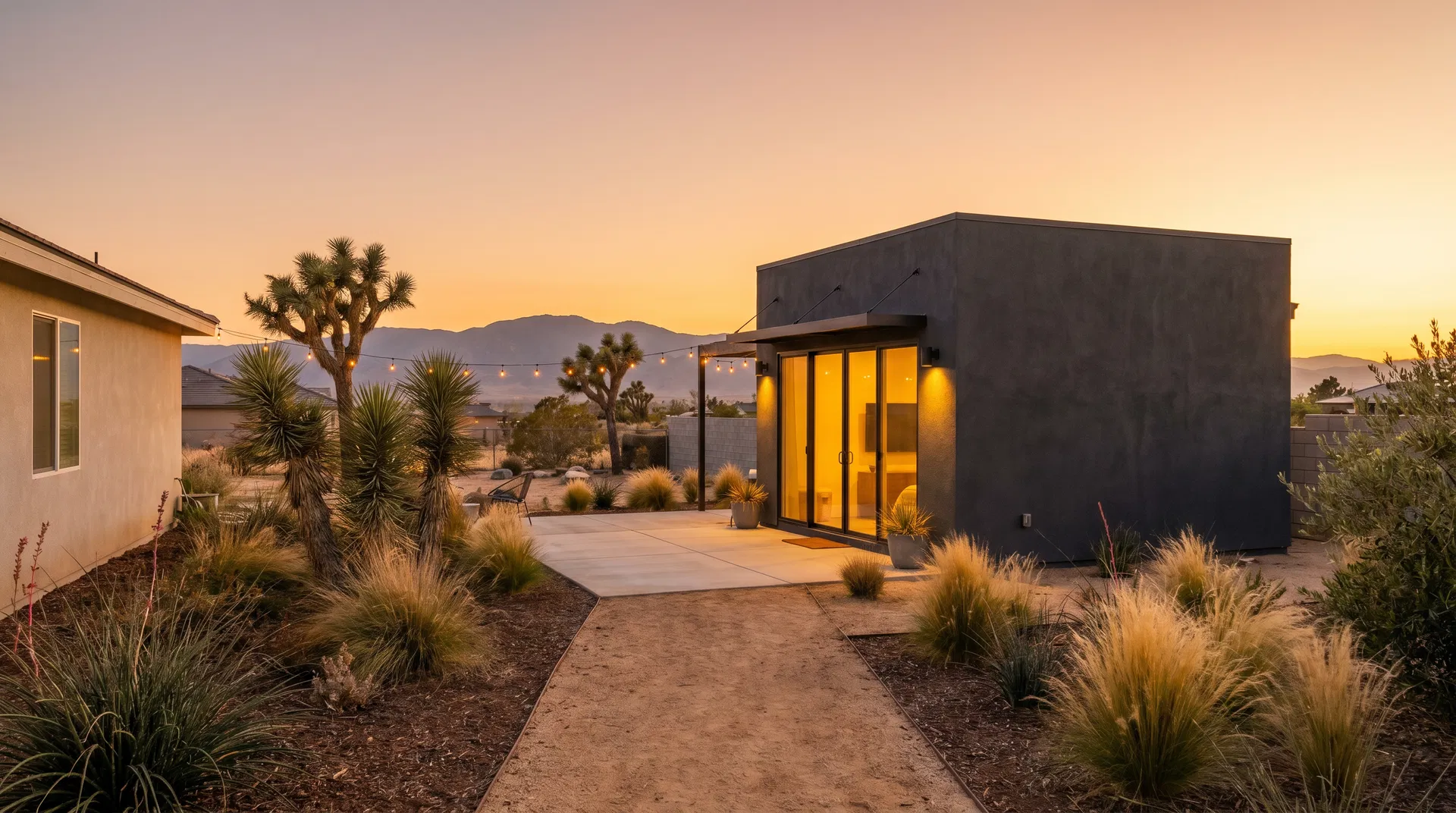
If you've been scrolling through Antelope Valley neighborhood groups lately, you've probably seen the phrase pop up: Sol Casita. Homeowners in Lancaster, Palmdale, and Quartz Hill are asking about them. Contractors are building them. And once you understand what one actually is, it's easy to see why.
A Sol Casita is a fully detached, fully finished backyard structure designed for one purpose: living well on your own property. Not storage. Not a guest room. A private lounge, bar, home theater, game room, or social club — built to your spec, permitted to California code, and designed to make the most of the 300-plus sunny days the Antelope Valley delivers every year. The name says it all: sol (Spanish for sun) meets casita (a small, finished dwelling). It's the backyard build that finally matches the lifestyle this region is built for.
Why the Antelope Valley Is the Perfect Setting
Most backyard entertainment structures were designed with coastal climates in mind — mild temperatures, ocean breezes, minimal temperature swings. The Antelope Valley is a different animal. Summers push past 100°F. Winters drop below freezing. Wind events roll through without warning. A standard pergola or open-air patio cover handles the sun but leaves you exposed to everything else.
A Sol Casita solves that problem permanently. With a fully insulated envelope, a properly sized mini-split HVAC system, and a sealed building shell, the interior stays comfortable year-round — 72°F whether it's July or January outside. You're not fighting the desert; you're building around it. That's the core insight that makes this structure so well-suited to the high desert: it gives you a climate-controlled social space that works on every day of the year, not just the 90 comfortable ones.
What Goes Inside a Sol Casita
The interior program is entirely up to you, but the most popular configurations we build at Spaulding Construction fall into a few clear categories:
The Social Lounge is the most requested layout — a custom bar with seating, a large-format TV or projector wall, comfortable sectional seating, and a game table. This is the build for the homeowner who hosts: football Sundays, poker nights, birthday parties, graduation gatherings. Everything happens in the Sol Casita, and the main house stays clean.
The Home Theater Suite centers on a 120-inch or larger projection screen, acoustic wall panels, tiered seating, and a dedicated sound system. Blackout shades, dimmable LED lighting, and a small concession bar complete the experience. For families with teenagers or adults who take film seriously, this configuration delivers a cinema experience that no streaming service can replicate.
The Fitness and Wellness Studio is a growing category — rubber flooring, mirrored walls, a dedicated HVAC zone for temperature control during workouts, and a recovery corner with a sauna or cold plunge. The Sol Casita's detached footprint means you can run loud music, drop weights, and keep the mess entirely separate from the main house.
The Hybrid is exactly what it sounds like: a bar on one end, a lounge in the middle, and a flex space at the back that converts between a workout area, a home office, and a guest sleeping space. For most families, this is the most practical configuration because it evolves with how you use the space over time.
Size, Cost, and What to Expect
Sol Casitas are sized by footprint, and the three most common builds we see in the Antelope Valley fall into a clear small, medium, and large range.
| Size | Footprint | Essential | Standard | Premium |
|---|---|---|---|---|
| Small | 15×25 ft (375 sqft) | $88,000–$131,500 | $131,500–$175,500 | $175,500–$263,000 |
| Medium | 25×35 ft (875 sqft) | $205,000–$307,000 | $307,000–$409,500 | $409,500–$614,000 |
| Large | 30×40 ft (1,200 sqft) | $281,000–$421,000 | $421,000–$561,500 | $561,500–$842,500 |
All prices reflect SoCal 2024–2025 construction costs including Spaulding Construction's standard markup. Final pricing depends on site conditions, permit fees, and your specific finishes.
Essential means a fully functional, insulated, climate-controlled structure with standard finishes — drywall, LVP flooring, recessed lighting, and a standard electrical panel. It's a clean, comfortable space ready for your furniture and fixtures.
Standard adds upgraded finishes — custom cabinetry, tile work, a wet bar rough-in, premium flooring, and a higher-capacity HVAC system. This is the most popular tier for homeowners who want the space to feel finished and impressive without going fully custom.
Premium is a full custom build — designer fixtures, custom millwork bar, home theater pre-wire, smart home integration, premium mini-split zoning, and exterior finishes that match or complement the main house. If you're building once and building right, this is the tier.
The most significant cost variables beyond the base build are full plumbing (adding a wet bar, half-bath, or kitchenette adds approximately $15,000–$60,000 depending on trench distance from the main line), a dedicated electrical sub-panel ($2,500–$4,000), and site prep or concrete work ($6,500–$23,500 depending on existing conditions).
The Permitting Reality in Antelope Valley
One of the most common questions we hear is: do I need a permit for a Sol Casita? The answer is yes — and that's actually a good thing.
A Sol Casita is a permanent, habitable structure. In Los Angeles County unincorporated areas, Lancaster, and Palmdale, any detached structure over 120 square feet requires a building permit. The permitting process covers structural engineering, electrical, mechanical (HVAC), and — if you're adding plumbing — a separate plumbing permit. Typical permit timelines in the Antelope Valley run four to eight weeks for plan check, depending on the jurisdiction and current backlog.
The benefit of going permitted is substantial. An unpermitted structure cannot be counted in your home's square footage for appraisal purposes, cannot be insured as a habitable space, and creates a disclosure obligation when you sell. A permitted Sol Casita, by contrast, adds directly to your assessed value, can be insured as a finished structure, and is fully disclosed as an asset — not a liability.
Spaulding Construction handles all permitting in-house. We prepare the plans, submit to the relevant jurisdiction (LA County, City of Lancaster, or City of Palmdale), respond to plan check corrections, and schedule all required inspections. You don't need to manage any of that process.
Setback and Lot Coverage Rules
Before you fall in love with a specific footprint, it's worth understanding the basic land use rules that apply to detached accessory structures in the Antelope Valley.
In most residential zones, a detached accessory structure must maintain a minimum five-foot setback from side and rear property lines. Corner lots have additional street-facing setback requirements. Lot coverage — the percentage of your lot that can be covered by structures — is typically capped at 40 to 50 percent of the total lot area in standard residential zones, though this varies by parcel and zoning designation.
The practical implication: a 1,200 sqft Sol Casita on a 7,500 sqft lot will require careful site planning to stay within coverage limits, especially if you already have a large main house footprint. On the larger lots common in Quartz Hill, Rosamond, and rural Lancaster, coverage is rarely a constraint. We review all of this during the free site consultation — it's one of the first things we check before discussing any design.
How a Sol Casita Affects Your Property Value
The honest answer is: it depends on how it's built and what the comparable sales in your neighborhood look like. A fully permitted, professionally finished Sol Casita adds to your home's appraised value as additional finished square footage. In the current Antelope Valley market, finished detached living space typically appraises at 60 to 80 percent of the per-square-foot value of the main house — meaning a well-built Sol Casita does not return dollar-for-dollar at resale, but it does return meaningfully.
More importantly, it makes your property significantly more competitive in a sale. A home with a 500-square-foot Sol Casita and a 1,200-square-foot main house will attract a different buyer profile — and often a higher offer — than a comparable home without one, because the buyer is purchasing a lifestyle, not just square footage. In a market where most homes look similar from the street, a Sol Casita is the differentiator that gets your listing saved, toured, and offered on.
Is a Sol Casita Right for You?
The best candidates for a Sol Casita are homeowners who already love their neighborhood and their lot but feel like they've outgrown their indoor entertaining space — or who want a dedicated space for a hobby, a fitness routine, or a business function that doesn't belong in the main house.
If you're asking whether the investment makes sense, consider this: the alternative is often a home addition, which is typically more expensive per square foot, more disruptive to your daily life during construction, and less flexible in how the space can be used. A Sol Casita gives you a completely separate building with its own climate, its own electrical, and its own front door — and it doesn't require you to live in a construction zone for six months while it's being built.
The Antelope Valley has the land, the sun, and the lifestyle to make a Sol Casita one of the most satisfying investments you can make in your property. The only question is what you want to put inside it.
Spaulding Construction has been building in the Antelope Valley since 1981. We offer free on-site consultations for Sol Casita projects in Lancaster, Palmdale, Quartz Hill, Rosamond, Acton, Littlerock, and surrounding communities. CA Lic #399458.