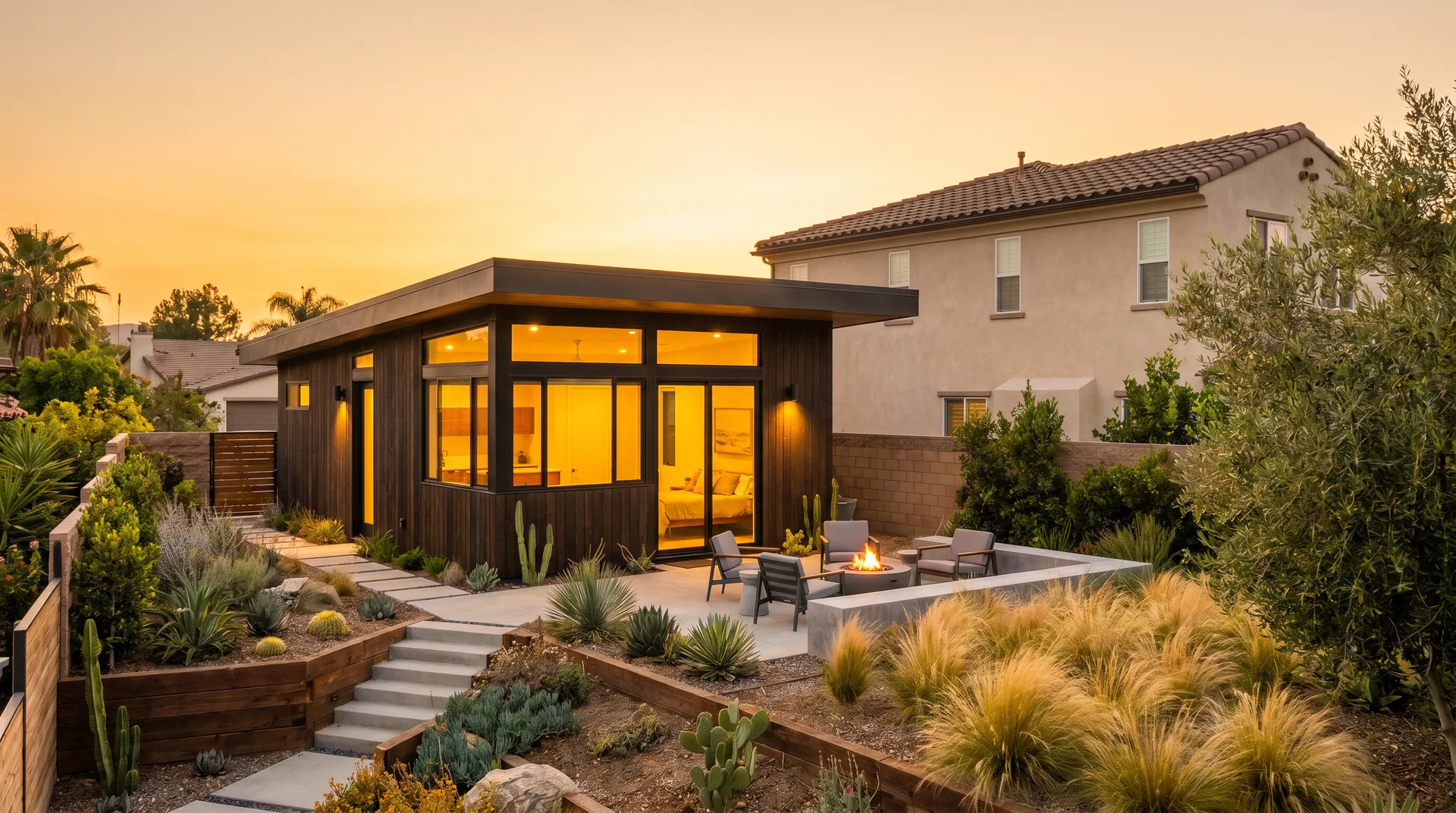
What Is an ADU — and Why Is Everyone Building One?
An Accessory Dwelling Unit (ADU) is a self-contained residential unit built on the same lot as a primary single-family home. It can take the form of a detached backyard cottage, a garage conversion, an attached addition, or even a basement apartment. In California, ADUs have exploded in popularity over the past five years — and for good reason. They solve multiple problems at once: the state's housing shortage, the homeowner's desire for passive income, and the growing need for multigenerational living arrangements.
If you own a home in the Antelope Valley — Lancaster, Palmdale, Quartz Hill, or the surrounding communities — you are sitting on one of the most underutilized financial assets available to a California homeowner. A well-built ADU can transform that asset into a revenue-generating property, a retirement income stream, or a private suite for aging parents or adult children.
The Numbers: What an ADU Actually Does to Your Property Value
The financial case for building an ADU is compelling and well-documented. According to a 2020 study by the UC Berkeley Terner Center for Housing Innovation, ADUs in California added an average of $25,000 to $100,000 in property value, depending on size, finish quality, and location. In higher-demand markets, that figure climbs significantly higher.
More importantly, ADUs affect how appraisers value your home. When a property includes a permitted, income-producing ADU, appraisers can use the income approach — factoring in the rental income the unit generates — rather than relying solely on comparable sales. In practical terms, this means a 600-square-foot ADU renting for $1,400/month in Lancaster can add $150,000 or more to your appraised value, depending on the capitalization rate used.
| ADU Size | Estimated Build Cost | Estimated Value Added | Typical Monthly Rent (Antelope Valley) |
|---|---|---|---|
| 400 sq ft Studio | $80,000–$110,000 | $80,000–$120,000 | $1,100–$1,400 |
| 600 sq ft 1BR | $110,000–$150,000 | $120,000–$175,000 | $1,300–$1,700 |
| 800 sq ft 2BR | $150,000–$200,000 | $160,000–$220,000 | $1,600–$2,100 |
| 1,000 sq ft 2BR | $190,000–$260,000 | $200,000–$280,000 | $1,900–$2,400 |
Estimates based on Antelope Valley market conditions as of 2025. Actual costs and values vary by site conditions, finishes, and permitting.
Rental Income: Turning Your Backyard Into a Revenue Stream
The Antelope Valley rental market is tight. Vacancy rates in Lancaster and Palmdale have remained below 4% for several consecutive years, driven by population growth, proximity to Edwards Air Force Base, and the ongoing migration of families priced out of Los Angeles County. This creates a strong, reliable tenant pool for ADU landlords.
A conservatively priced 600-square-foot one-bedroom ADU renting at $1,400/month generates $16,800 per year in gross rental income. After accounting for a typical mortgage payment on a $130,000 construction loan at 7% over 20 years (approximately $1,008/month), the net monthly cash flow is roughly $392 per month — before tax benefits. And unlike a stock portfolio, this income is backed by a hard asset you already own.
Many Spaulding Construction clients who built ADUs in 2021 and 2022 have since paid off a significant portion of their construction costs through rental income alone, while simultaneously watching their property values appreciate.
Quality of Life: The Benefits That Don't Show Up on a Spreadsheet
Beyond the financial returns, ADUs offer quality-of-life improvements that are harder to quantify but equally real.
Multigenerational living. California's housing costs have made it increasingly difficult for adult children to live independently near their parents. An ADU provides a private, dignified living space for a college graduate, a recently divorced family member, or an aging parent who needs proximity but values independence. It eliminates the awkwardness of shared bathrooms and kitchens while keeping family close enough for daily connection.
Aging in place. For homeowners approaching retirement, an ADU offers a path to stay in the home they love. Many clients build an ADU, move into it, and rent out the main house — dramatically reducing their housing costs while maintaining ownership of their property. Others build the ADU for a caregiver, ensuring help is always nearby without the cost of assisted living.
Home office and creative space. A detached ADU provides a level of separation from the main house that a spare bedroom simply cannot match. Whether you work from home, run a small business, or need a dedicated studio for art, music, or fitness, a properly designed ADU gives you a professional-grade workspace steps from your back door.
California's ADU-Friendly Laws: What Changed and Why It Matters
California has made it significantly easier to build ADUs over the past several years through a series of legislative reforms. Key changes include:
- No owner-occupancy requirement — As of 2020, California law no longer requires the property owner to live on-site to build or rent an ADU.
- Reduced setbacks — ADUs can now be built as close as 4 feet from the rear and side property lines in most cases.
- Streamlined permitting — Local agencies must approve or deny ADU applications within 60 days. Many jurisdictions offer pre-approved standard plans to further accelerate the process.
- No impact fees for small ADUs — ADUs under 750 square feet are exempt from most local impact fees, significantly reducing the total cost.
- Junior ADUs (JADUs) — Homeowners can also convert existing interior space (such as a bedroom or attached garage) into a JADU of up to 500 square feet with minimal permitting requirements.
The City of Lancaster and the City of Palmdale have both adopted ADU-friendly local ordinances that align with or exceed state minimums, making the Antelope Valley one of the more permissive jurisdictions in Southern California for ADU development.
What to Expect From the Build Process
A typical detached ADU project with Spaulding Construction follows a clear, predictable timeline:
- Site assessment and design consultation (Week 1–2): We evaluate your lot, discuss your goals, and recommend the optimal size, placement, and design for your ADU.
- Architectural plans and permit submittal (Week 3–8): Our team prepares permit-ready drawings and submits to the city. Antelope Valley jurisdictions typically take 4–8 weeks for plan check.
- Foundation and framing (Week 9–12): Once permits are issued, construction begins with foundation work followed by framing.
- Mechanical, electrical, and plumbing rough-in (Week 13–15): All systems are installed and inspected before walls are closed.
- Insulation, drywall, and finishes (Week 16–20): Interior finishes, cabinetry, flooring, and fixtures are installed.
- Final inspection and certificate of occupancy (Week 21–24): The city conducts a final inspection and issues the certificate of occupancy, making the unit legal to rent.
Most ADU projects are complete within 5–7 months from permit submittal, depending on plan check timelines and site conditions.
Is an ADU Right for Your Property?
The best candidates for ADU construction share a few common characteristics: a lot size of at least 6,000 square feet, a single-family home with a rear yard that isn't fully occupied by a pool or other structure, and a homeowner with a clear goal — whether that's rental income, family housing, or long-term property value appreciation.
If you're curious whether your property qualifies and what a realistic budget and timeline would look like, the best first step is a free site consultation. Spaulding Construction has been building in the Antelope Valley since 1981, and our team can walk your property, answer your questions, and give you a straight answer — no pressure, no obligation.
Call us at (661) 228-3120 or fill out our contact form to schedule your free ADU consultation today.